
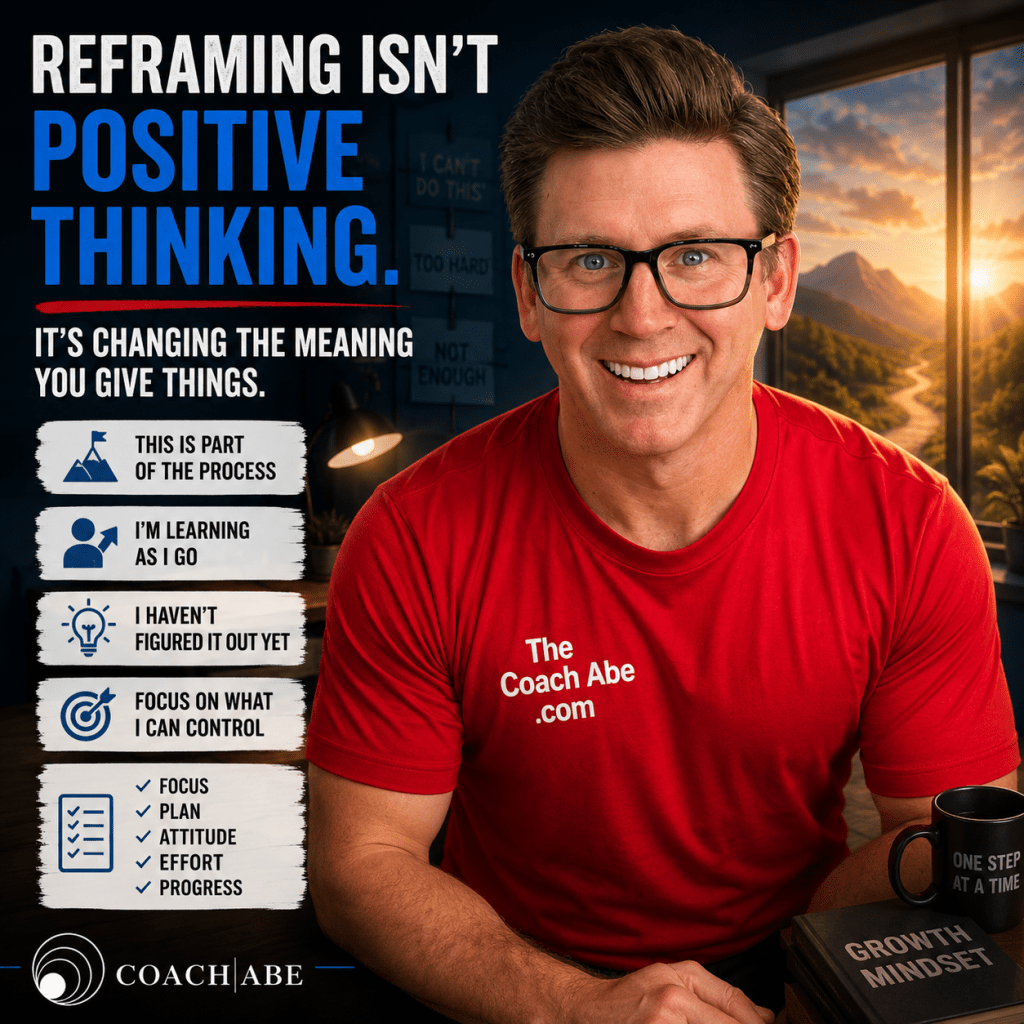
When people hear the word reframing, they often think it means forcing a positive perspective.
Looking for the good
Staying optimistic
Trying to feel better about a situation
That approach sounds helpful, but it often feels forced.
Because in difficult moments, simply trying to think positively doesn’t always match what you’re experiencing.
And when it doesn’t feel real, it doesn’t last.
Reframing is not about convincing yourself that everything is good.
It’s about changing the meaning you give to what’s happening.
What’s Actually Happening When You Reframe
Every situation is neutral until your mind interprets it.
Something happens
Your mind assigns meaning
That meaning shapes how you feel
And how you feel influences how you respond
Most people try to change how they feel.
But emotions are a result, not a starting point.
If the meaning stays the same, the emotional response tends to stay the same as well.
Reframing works at the level where the meaning is created.
Why Positive Thinking Often Doesn’t Work
Positive thinking focuses on replacing negative thoughts with better ones.
But when a thought doesn’t feel believable, your mind resists it.
For example:
“This is a great opportunity”
“Everything is working in my favor”
If that doesn’t align with your current experience, it creates tension.
Part of you is trying to accept the thought.
Another part is rejecting it.
That internal conflict makes it hard to stay consistent.
Reframing takes a different approach.
It doesn’t force a better thought.
It looks for a different, more accurate way to understand the situation.
How Meaning Shapes Your Response
The way you interpret something determines how you respond to it.
If you see a challenge as a setback, you may hesitate or pull back.
If you see the same challenge as part of a process, your response shifts.
You stay engaged
You remain open
You continue moving forward
The situation hasn’t changed.
But your interpretation of it has.
And that changes everything that follows.
The Pattern Most People Miss
Your interpretations are often automatic.
They are shaped by past experiences, repeated thoughts, and familiar emotional responses.
Over time, your mind develops patterns.
So when something happens, it quickly assigns a meaning based on what it already knows.
That’s why different situations can feel similar.
Not because they are the same.
But because they are being interpreted the same way.
What Most People Try Instead
Instead of examining their interpretations, most people try to improve their reactions.
They try to stay calm
Think positively
Control their emotions
But if the meaning underneath stays the same, those efforts feel temporary.
You can manage your response for a short time.
But eventually, the original interpretation pulls you back into the same pattern.
The Shift: Changing the Meaning
Reframing starts by identifying the meaning you’re currently giving a situation.
When something feels difficult, pause and ask:
“What meaning am I giving this right now?”
This question brings your attention to the source of your response.
Not the situation.
The interpretation.
Once you see that, you can begin to explore alternatives.
Not forced positivity.
Just different ways of understanding what’s happening.
What You’ll Start to Notice
As you practice reframing, patterns become clearer.
You may notice that:
You assign limiting meanings quickly
You assume negative outcomes without much evidence
You interpret challenges as problems instead of processes
And once you see that, something shifts.
You realize that meaning is not fixed.
It’s created.
And what is created can be adjusted.
A More Useful Way to Reframe
Reframing doesn’t require you to jump to a positive conclusion.
It can be as simple as asking:
“What else could this mean?”
“What might this be developing in me?”
These questions don’t force an answer.
They create space.
And in that space, new perspectives become available.
Not because you pushed for them.
But because you allowed them.
Final Thought
Reframing is not about making things look better than they are.
It’s about seeing them more clearly.
Because the meaning you give to a situation shapes how you experience it and how you respond to it.
If that meaning stays the same, your results tend to repeat.
But once you begin to shift the meaning, even slightly, your response begins to change.
And that change, repeated over time, leads to a different direction.
Start with awareness. Use the worksheets to identify how you interpret situations, and begin practicing reframing one thought at a time.
 The Coach Abe
Leave a comment