
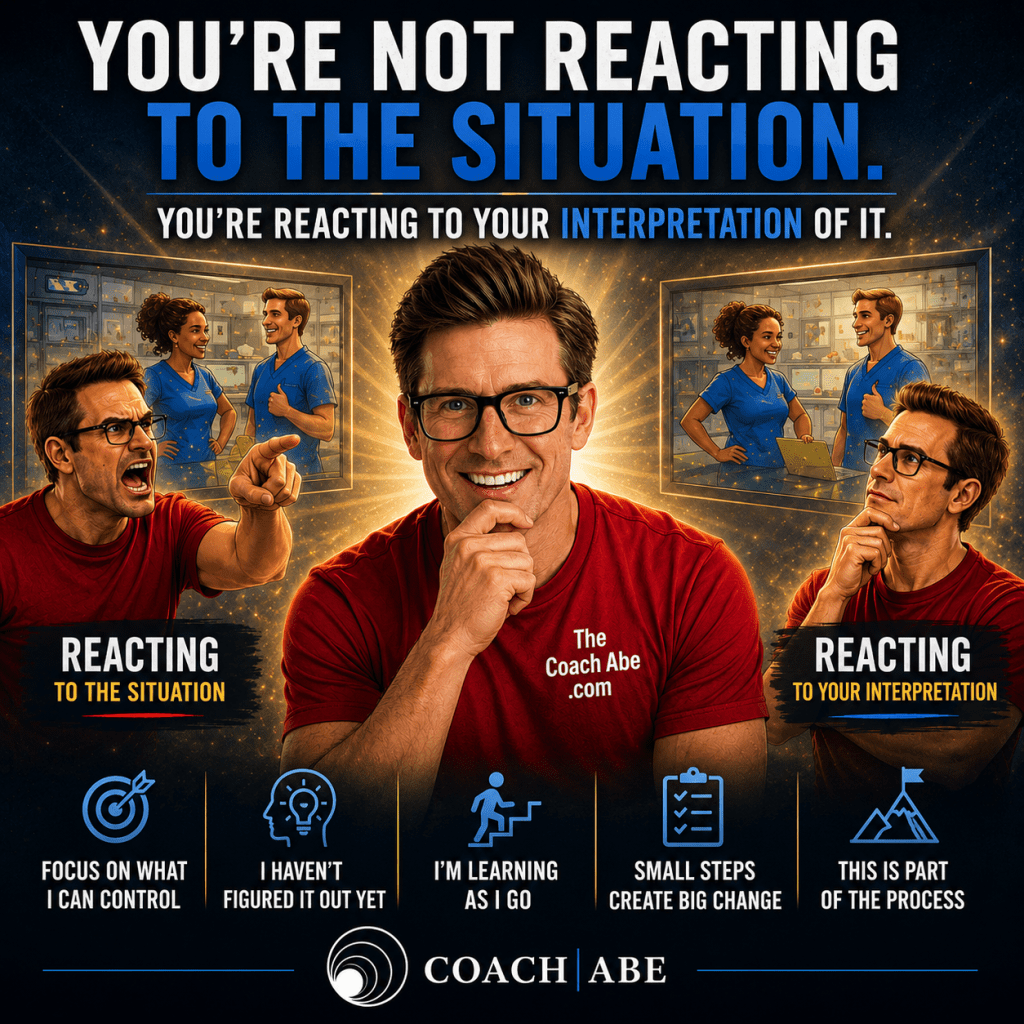
When something happens, it feels like your reaction is automatic.
A situation unfolds
You respond
It seems direct and immediate
Most people assume their reaction is caused by what just happened.
But there’s a step in between that often goes unnoticed.
You don’t respond to the situation itself.
You respond to what you believe the situation means.
And that meaning is created instantly.
What’s Actually Happening in the Moment
Every situation goes through an internal filter before you react to it.
Something happens
Your mind interprets it
That interpretation creates meaning
And that meaning shapes your response
This process is fast. It feels automatic.
Because of that, it’s easy to assume that your reaction is tied directly to the event.
But two people can experience the same situation and respond completely differently.
Not because the situation changed.
But because their interpretation of it did.
Why Your Interpretation Feels Like Reality
Interpretations don’t feel like opinions.
They feel like facts.
When your mind assigns meaning to something, it doesn’t label it as a perspective. It presents it as the truth.
For example:
“They ignored me”
“This isn’t going well”
“I’m about to fail”
These thoughts feel accurate in the moment.
But they are interpretations, not objective reality.
And because they feel true, you react accordingly.
How Patterns Shape Your Interpretation
Your interpretations are not created from scratch each time.
They are influenced by past experiences, repeated thoughts, and familiar emotional responses.
Over time, your mind learns patterns.
So when something happens, it doesn’t pause to evaluate it objectively.
It matches the situation to something familiar and produces a similar interpretation.
That’s why different situations can trigger the same reaction.
Not because they are the same.
But because they are being filtered the same way.
What Most People Try to Change
When reactions don’t lead to good outcomes, most people focus on controlling their behavior.
They try to:
Stay calm
Be more patient
Respond more positively
Handle situations better
But if the interpretation underneath stays the same, those efforts feel difficult to maintain.
You’re trying to change your reaction without changing what’s driving it.
That creates tension.
Because your internal meaning is pulling you in one direction, while you’re trying to act in another.
The Shift: Seeing the Interpretation
The goal is not to immediately change how you react.
The first step is to see what’s happening before the reaction.
When something triggers you, pause and ask:
“What meaning did I just give this?”
This question shifts your focus.
Instead of looking only at the situation, you begin to notice your interpretation of it.
And that’s where the real influence is.
What You’ll Start to Notice
As you practice this, patterns become easier to recognize.
You may notice that:
You assign negative meaning quickly in uncertain situations
You assume outcomes before they happen
You interpret neutral events in a critical way
And once you see that, something becomes clear.
The situation is only part of the experience.
Your interpretation is the part shaping your response.
A Better Way to Respond
When you notice your interpretation, you don’t need to immediately replace it.
You can acknowledge it in a neutral way:
“That’s how I’m interpreting this right now”
“That’s a familiar way I see situations like this”
This creates space between you and the interpretation.
You’re no longer fully inside it.
You’re observing it.
And from that position, different responses become available.
Not forced.
But accessible.
Final Thought
You’re not reacting to what’s happening.
You’re reacting to the meaning you assign to what’s happening.
If that meaning stays the same, your responses tend to repeat.
Even in different situations.
But once you begin to notice your interpretations, you create space to question them.
And in that space, your response can change.
Not because the situation is different.
But because you’re no longer seeing it the same way.
Start with awareness. Use the worksheets to identify how you interpret situations, and begin shifting your responses one thought at a time.


Leave a Reply